The Work of Carl Gauss
Mathematics often progresses through the insights of individuals whose intellectual ability and originality place them at the center of entire fields. Few figures in the history of mathematics embody this more fully than Carl Friedrich Gauss, whose work included efforts in arithmetic, geometry, astronomy, physics, and analysis. His ideas were not isolated innovations but rather developed theories with a “few but ripe” motto shaping the direction of modern mathematics. This paper aims to explore Gauss’s background, his principal contributions across several mathematical domains, and his enduring influence, demonstrating why he is widely referred to as the “Prince of Mathematics.”
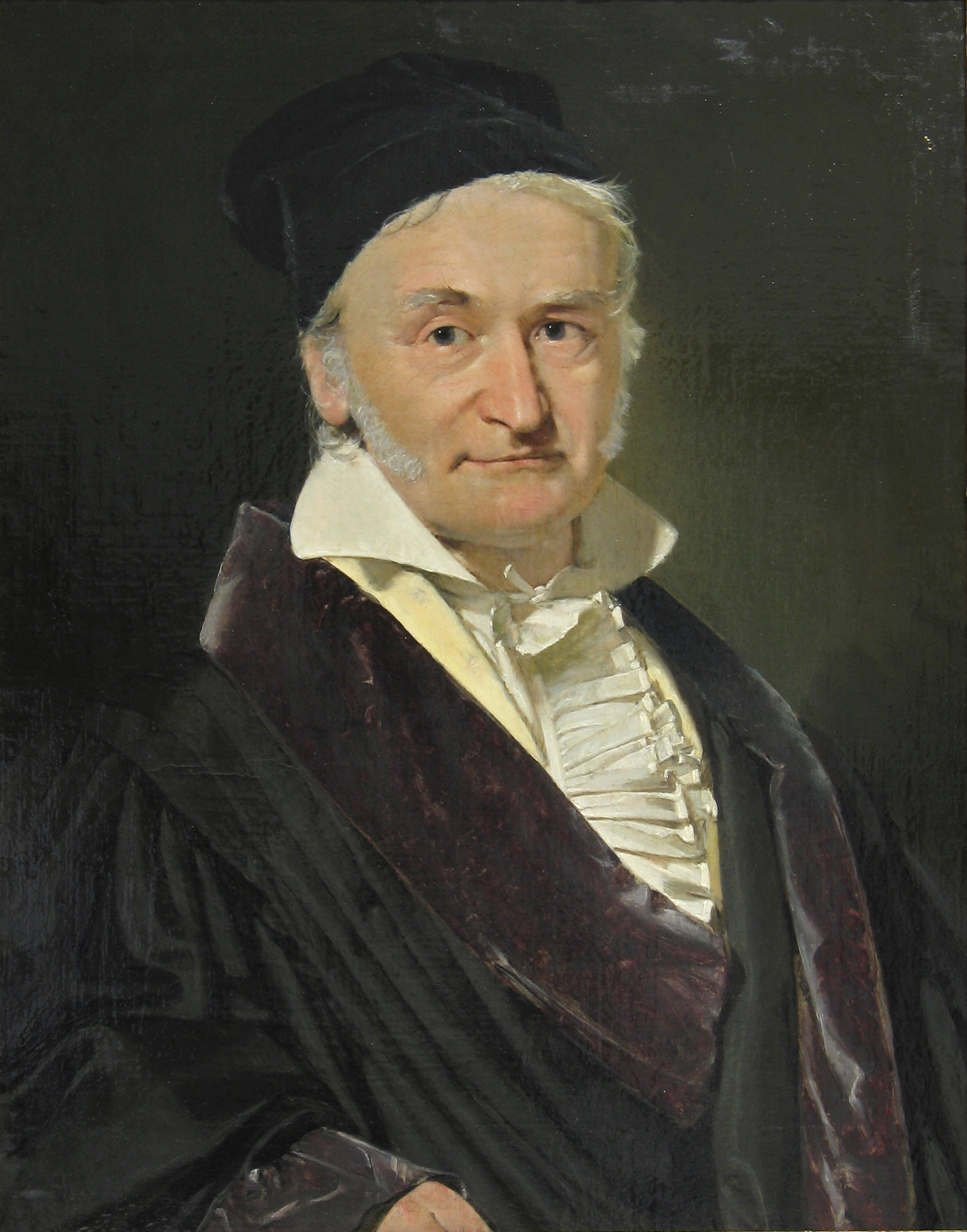
Carl Friedrich Gauss (Fig. 1) was born on April 30, 1777, in Brunswick, Germany, the only child and of modest means. From a young age of seven, Gauss “started elementary school, and his potential was noticed almost immediately” when he astounded his teachers by allegedly summing the integers from 1 to 100 almost instantly, recognizing “that the sum was 50 pairs of numbers each pair summing to 101” (O’Connor & Robertson). His abilities earned him a solid education despite his lack of money, in which “his teachers gave him advanced textbooks and introduced him to the work of prominent mathematicians of the day” (National MagLab). He eventually gained the patronage of the Duke of Brunswick, allowing Gauss to “study at Brunswick Collegium Carolinum, then at the University of Göttingen in 1795” where he continued his education until 1798. While still a student, Gauss made contributions to mathematics, where “in 1796, he demonstrated that the heptadecagon […] is geometrical constructible,” considering this discovery to be so significant that “he requested a heptadecagon be inscribed on his headstone when he died.” These early feats in his early educational journey in his impression of his teachers in his elementary schooling and geometric construction of the 17-sided polygon reveal a rare combination of rigor, intuition, and creativity. This demonstrates the very beginnings of the amazing abilities that would establish Carl Gauss as the greatest mathematician of his time.
Following his early prodigious feats, Gauss turned his analytical thought toward the systematic study of number theory, culminating in his work Disquisitiones Arithmeticae in the summer of 1801. While contemporaries such as Legendre has published important number-theoretic results by 1798, Gauss noted in the preface to his book that he had “written most of it before studying the works of some of his contemporaries” (Katz), underscoring his independent approach to mathematics. In Disquisitiones, Gauss introduced modern notation and definitions for congruence, presenting it as “the integers b and c are congruent relative to the modulus a if a divides the difference of b and c,” otherwise expressed as b ≡ c (mod a). He also “proved the analogue of the fundamental theorem of arithmetic, using theorems similar to those in Euclid’s Elements”, calculated Euler’s φ(n) function, and proved properties of primitive roots. Gauss also “discussed the solution of cyclotomic equations, equations of the form xn − 1 = 0, and the application of these solutions to the construction of regular polygons” where his main efforts were determining a solution algebraically, where the equation xn−1 + xn−2 + … + x + 1 = 0 became his primary focus for his work in, as mentioned before, his constructability in a 17-sided polygon. He also exhaustively treated quadratic reciprocity with six distinct proofs and significantly advanced prior work and explored higher reciprocity laws through Gaussian integers. Beyond these achievements in number theory, Gauss also engaged in correspondence with Sophie Germain on approaches to Fermat’s Last Theorem, where surprisingly he states that “When a person of the [female] sex […] encounters infinitely more difficulties than men, […] then without doubt she must have the noblest courage, quite extraordinary talents, and a superior genius.” These accomplishments and understandings reveal Gauss’s brilliance as not just mechanical and computational, but deeply structural and supportive of women in their pursuits of mathematics, providing yet another case to crown himself a title as the greatest mathematician in his major results and correspondence of major mathematicians, and also unifying discrete results into a single coherent and rigorous framework, further establishing him as the most visionary of mathematicians.
Gauss’s engagement with polynomial equations manifested in his first proof of the Fundamental Theorem of Algebra in his 1799 doctoral thesis, establishing that “every polynomial equation of degree n with complex coefficients has n roots in the complex numbers” (O’Connor & Robertson). Building on algebraic advancements from figures like Cardan and Al-Khwarizmi led to his argument that their earlier proofs assumed nonexistent roots, claiming “…if one carries out operations with these impossible roots, as though they really existed… I can only say that I thoroughly disapprove of this type of argument.” His proofs introduced rigorous topological and algebraic reasoning, especially in his revisiting of the proof where he refines and demonstrates that polynomials with complex coefficients indeed always have n roots. Rejecting the initial assumption of preexisting roots and operating instead of indeterminates, Gauss formalized a logical foundation underpinning later complex analysis and algebraic theory. Even in his early dissertation, Gauss was solving not simple specific problems or cases but shaping the foundations and structures of mathematical reasoning, indeed earning his reputation as an integral and influential mathematician.
Astronomical and statistical contributions were also met by the great Carl Gauss in the remarkable discovery of the method of least squares in his prediction of the orbit of the newly discovered dwarf planet Ceres (Lim). When Ceres was lost shortly after initial observation in 1801, astronomers had to extrapolate its position from only nineteen data points subject to random measurement errors. Gauss’s insight was to formalize the “law of probable errors” recognizing that “small errors are more likely than large errors; the likelihood of errors of magnitudes x and −x are equal” (or the distribution is symmetrical). Employing these principles, he derived the normal distribution and applied his least squares method to estimate the six parameters of Ceres’s orbit such that astronomers were able to rediscover Ceres, where Gauss notes that “this first application of the method [of least squares] … restored the fugitive [planet] to observation.” The derivation of the method of least squares and its application in its rediscovery of Ceres showcase Gauss’s remarkable skill which laid the groundwork for modern statistics of regression and error analysis. Gauss reflects that “it is not knowledge, but the act of learning, not possession, but the act of getting there, which grants the greatest enjoyment.”
Carl Friedrich Gauss stands as the most influential figure in the history of mathematics. His widespread contributions, even at a young age, reveal his prodigious nature and understanding of mathematics at its very structural core, even in the exploration of his early work. Gauss’s command of the mathematical language spanned number theory, algebra, astronomy, statistics, and so much more and is regarded as one of the last true mathematical generalists, highlighting the establishment of rigorous foundations and insightful methods that remain central to modern mathematics, securing him as the greatest mathematical mind in history, and enduring his reputation as the “Prince of Mathematics.”
References #
- Katz, V. J. (2018). A history of mathematics: An introduction (3rd ed.). Pearson.
- Lim, M. (2021). Gauss, least squares, and the missing planet. Actuaries Institute. https://www.actuaries.asn.au/research-analysis/gauss-least-squares-and-the-missing-planet
- National MagLab. (2025). Carl Friedrich Gauss. https://nationalmaglab.org/magnet-academy/history-of-electricity-magnetism/pioneers/carl-friedrich-gauss/
- O’Connor, J. J., & Robertson, E. F. (1996). Fundamental theorem of algebra. MacTutor History of Mathematics Archive. https://mathshistory.st-andrews.ac.uk/HistTopics/Fund_theorem_of_algebra/
- O’Connor, J. J., & Robertson, E. F. (1998). Carl Gauss. MacTutor History of Mathematics Archive. https://mathshistory.st-andrews.ac.uk/Biographies/Gauss/